Showing posts with label World War 1. Show all posts

Friday, September 06, 2024

London Trip 11 - Churchill's War Room

We arrived and got in line for tickets to the Churchill War Room Tour.

We waited in line for tickets beside a couple very friendly Aussies who were visiting London, and we had a very nice chat to pass the time before we got in. 

The War Room is a bunker complex located beneath the Treasury building in Westminster. The complex became operational a week before Britain declared war on Germany and remained open and active until the end of the Second World War. The complex has been preserved to look as it did during the war years.

Inside, you can see where Churchill and the Cabinet conducted the war.

The complex is tight to maneuver in and full of offices and areas for running the war.

Security in the complex was rather tight:

The threat of bombardment was a real concern as the bunker complex was not quite as bomb-proof as they would have liked.

Some notices are rather polite:

The bunker complex is quite interesitng with lots of recorded recollections written up rfom people who worked in the bunker posted for people to read and learn about the experience.  It's very much walking through a place where history was made and a war won due to the decisions made in these rooms.

The bunker also had a very informative poster, and very knowledgeable and helpful docent who explained the secret and secure encrypted communication line that had been setup between Churchill and FDR - the SIGSALLY.:

A very cool bit of cryptography history and technology right there.

In addition to the bunkers setup as they were in Churchill's time, there's a museum dedicated to the man.

The museum has a display oif the many hats  Churchill wore: 


There's also Churchill's sidearm from when he served on the Western Front in World War 1 when commanding the Royal Fusilliers:

Yes, it is a Colt 1911.

The Nazis used a famous photo of Churchill in their propaganda against him:


It likely didn't , work nor change anyone's mind.  Indeed international and national socialists both are always quick to accuse their opponents of what they themselves are doing.

The museum recounts Churchill's life and career in politics and the military, complete with his foibles and mistakes and all. It gives an excellent picture of the man and his incredible work ethic, life and legacy.


Did you know that Churchill was a pilot?  He learned to fly in 1913:


Did you know that Churchill was awarded honorary American Citizenship?


Now you do.  Back when Civus Americanus Sum had some weight behind it.

You definitely get a very good sense of Churchill the man, his legacy, and his massive impact on history. 

The museum is a very well done and is worthy of  a visit when you are in London.

Friday, August 04, 2023

NCL Cruise Day 2 - In Bruges - Tyne Cot Cemetary

Our tour guide was a retired British Commonwealth War Graves Commission member, who had worked on preserving war graves throughout the world.  He had been decorated with an MBE by Queen Elizabeth II herself for his service.  To say he knew his stuff and had tremendous knowledge about what we about to see was an understatement. 

He gave a good overview of the history of the Ypres Salient in World War One, and of Tyne Cot Cemetary in particular.

Visiting Tyne Cot Cemetery is sobering to say the least.

Located on what was a German bunker emplacement in the First World War, 9 km northeast of Ypres,  it is the largest Commonwealth War Grave cemetery in terms of number of burials.  11,961 service members who died in the Ypres Salient are buried there.


The Memorial Cross is located on top of the main German bunker.

Of the 11,961 servicemen buried there, 8,373 are unknown.

British soldiers' headstones are marked by the deceased's regimental badge:

Other nations are represented by their nation's symbol.

Many Commonwealth soldiers are buried in the cemetery, including the grave of Captain Clarence Jeffries, an Australian who posthumously earned the Victoria Cross for his valor in the Battle of Passchendaele:

When the soldier is unknown, the message on the marker will state "A (Regiment or Nation) Soldier Of The Great War, Known Unto God". 


Often, not even their nationality is known:

There are so, so, many only "Known Unto God" grave markers throughout the cemetery.

If you see headstones grouped together, it means those soldiers were known to have died together and their bodies could not be separated for burial.


The cemetery changed hands throughout the war and was subject to artillery bombardment.  As a result, bodies known to be buried there could not always  be located and identified when the cemetery was retaken:


German soldiers, including unknown soldiers, are also buried there, and their graves are also tended to:

The Cemetery also has the memorial to those fallen soldiers of New Zealand whose grave locations are still unknown, as there was insufficient space to list these unknown soldiers on the Menin Gate Memorial:


A further memorial to British soldiers also lost and whose resting places are unknown is nearby the New Zealand Memorial, with panel after panel listing the missing by regiment.


Combined, there are almost 35,000 names of British and New Zealand soldiers on those panels upon panels on the walls, all of whose resting places are unknown.

Tyne Cot Cemetery is a place that conveys the immense horrors and tremendous loss of the First Word War.

Monday, June 10, 2019

The University of Toronto Soldier's Tower

I had a nice visit this weekend with the family in Toronto.

The weather decided to be pleasant for a change, so we went for a stroll along the grounds of the University of Toronto, which is located in the heart of Toronto itself.

The University grounds were rather quiet and uncrowded in the green space set in the middle of downtown, as most of the students have departed for the summer.

Amongst the fine architecture, along the walking path, we first approached and then walked under this large bell tower.

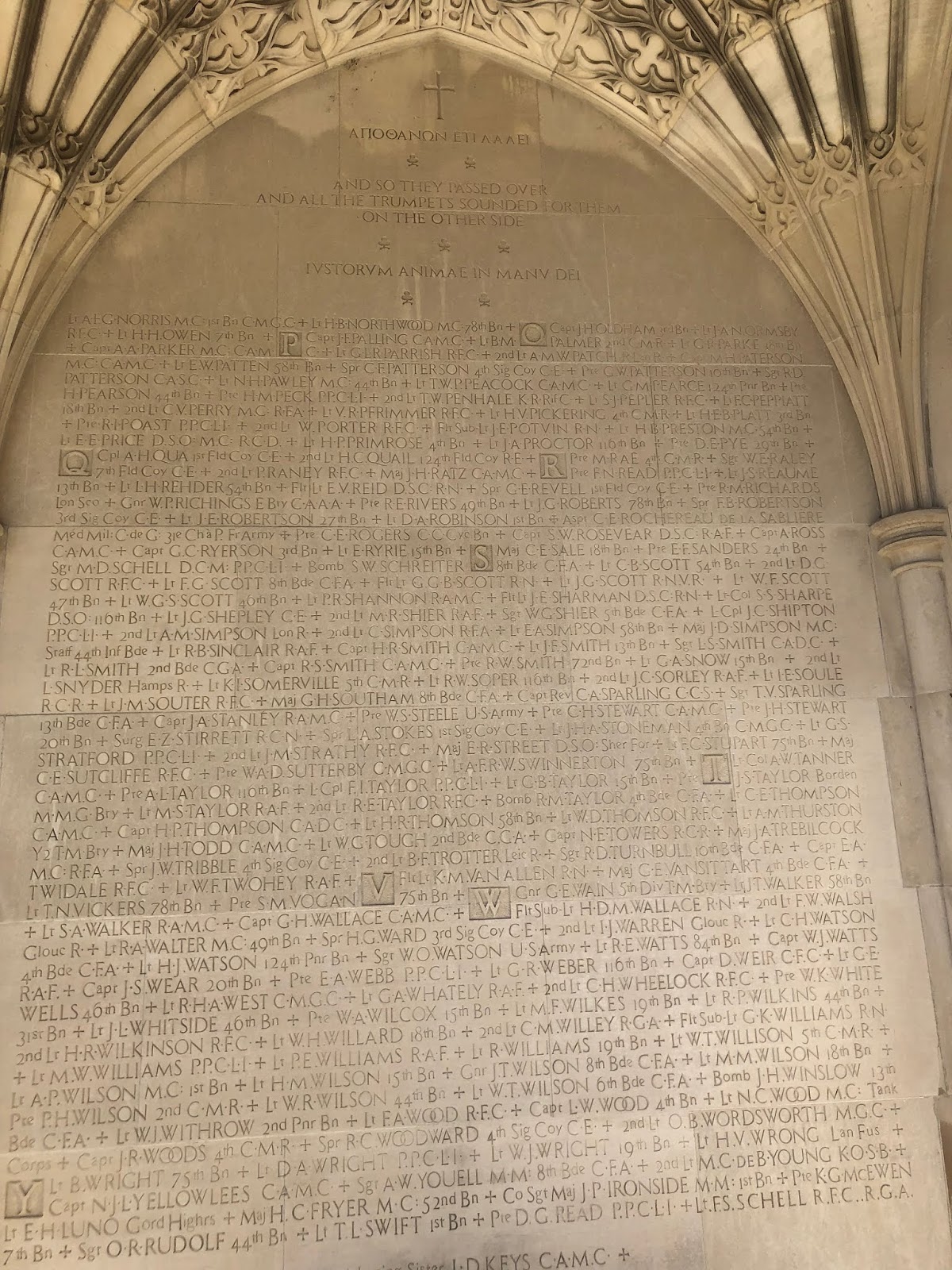
At base if the tower was an alcove with a chain running across it. Within the alcove were inscribed the names of all those from the University of Toronto who had died in the First World War.

The first panel has In Flander's Fields inscribed upon it (click to embiggen).

Then come the lists of names.

A closing panel contains a final admonition:

628 University of Toronto students, faculty, staff, and alumni, 627 men and one woman, Nursing Sister L.D. Keys CAMC, who died in World War 1.

As I found out later, there's another archway that contains a memorial and a list of names of the 557 members from the University of Toronto who died in World War 2.

The 143-foot tall tower with its bell carillon was built in 1923-1924 with donations from the University of Toronto Alumni. The money raised back then is in an endowment and is still used for scholarships and tower maintenance expenses, and continues to stand today as a monument for those who gave their lives in the service of their country from the University of Toronto.

Monday, June 08, 2015

Better Late Than Never


It often takes quite some time for a bureaucracy to do the right by those who served it above and beyond the call.

In this case it took 97 years.

The Detroit News: Black, Jewish WWI heroes finally getting Medal of Honor

Sgt. Shemin was featured on this blog last December when there was news that he might finally get his Medal of Honor.  Now, six months later it is finally awarded.

Private Johnson similarly has finally received official recognition for his heroism that was overdue for these many years.

Wednesday, December 17, 2014

Medal of Honor Delayed For 96 Years May Be Awarded During Hannukah


Recognition of a great act of heroism long delayed may happen shortly.

From Fox News: A century after heroism, Jewish soldier may soon get posthumous Medal of Honor
Nearly a century ago, Sgt. William Shemin raced across a World War I battlefield three times to pull wounded comrades to safety. With all the senior leaders of the platoon wounded or killed, the 19-year-old survived a bullet to the head and led his unit to safety.
The heroism should have earned Shemin the Medal of Honor, the nation's highest service medal. But it didn't, perhaps because discrimination was rampant in the military — and he was Jewish.
Thanks to the efforts of his now 85-year-old daughter, Shemin is on the cusp of finally being honored with a medal, 41 years after his death.
The Senate on Friday passed the $585 billion defense bill. A small provision allows President Barack Obama to bestow the Medal of Honor to Shemin. The last hurdle is Obama's signature on the defense bill.
Should the bill be signed, it would certainly be fitting for the ceremony to take place during the celebration of Hanukkah, a holiday that commemorates an ancient Jewish military victory and the valor of the Jewish warrior.

Monday, December 19, 2011

A Classic Read - The Emma Gees

I'm currently reading Herbert W. McBride's The Emma Gees, about his service as an American in the Canadian Army in World War I with a machine gun section. McBride relates his training and combat experiences, including sniping on the Western Front.

Better known for his work A Rifleman Went To War which holds a major place in sniper and shooting lore, McBride's The Emma Gees is a great read.

You can now get the Emma Gees for free at the Project Gutenberg library, or Free for the Kindle at Amazon, or In Paperback Form from Amazon.

Any way you get it, it is well worth reading.

One of the most striking things about the book is how erudite Mr. McBride is and how it is conveyed in his writing. His vocabulary is very rich and wide, and he knows the history of the land he travels through in England and in France at a level that the average college graduate of today would be hard pressed to match.

He vividly conveys the conditions of trench warfare and his combat experiences in a prose that is both very readable and well suited to his tale. I'd highly recommend giving the Emma Gees some of your reading attention as a vivid first hand account of the Great War.

An obituary for Mr. McBride, who died in 1933 from a heart condition at the age of 59, appeared and can be read in the NRA's American Rifleman.