Showing posts with label Bruges. Show all posts

Tuesday, August 08, 2023

NCL Cruise Day 2 - In Bruges - In Flanders Fields Itself

 We took the bus to the Essex Farm Cemetery.

 The cemetery has the bodies of many of those who died during the Ypres battles.

The West Yorkshire Regiment had a lot of its soldiers buried in Essex Farm.


 As always in First World War cemeteries, there lie the unknowns.

Beside the cemetery is a bunker complex used for medical operations near the front lines.

The bunker, on the backside of a hill from the battlefront, is dark and incredibly cramped, with some spaces no larger than your wingspan.  


Sandbags from the bunker line the road across from the bunker entrances.  The sandbags have since been filled with cement rather than sand but the bags themselves date back to the First World War.


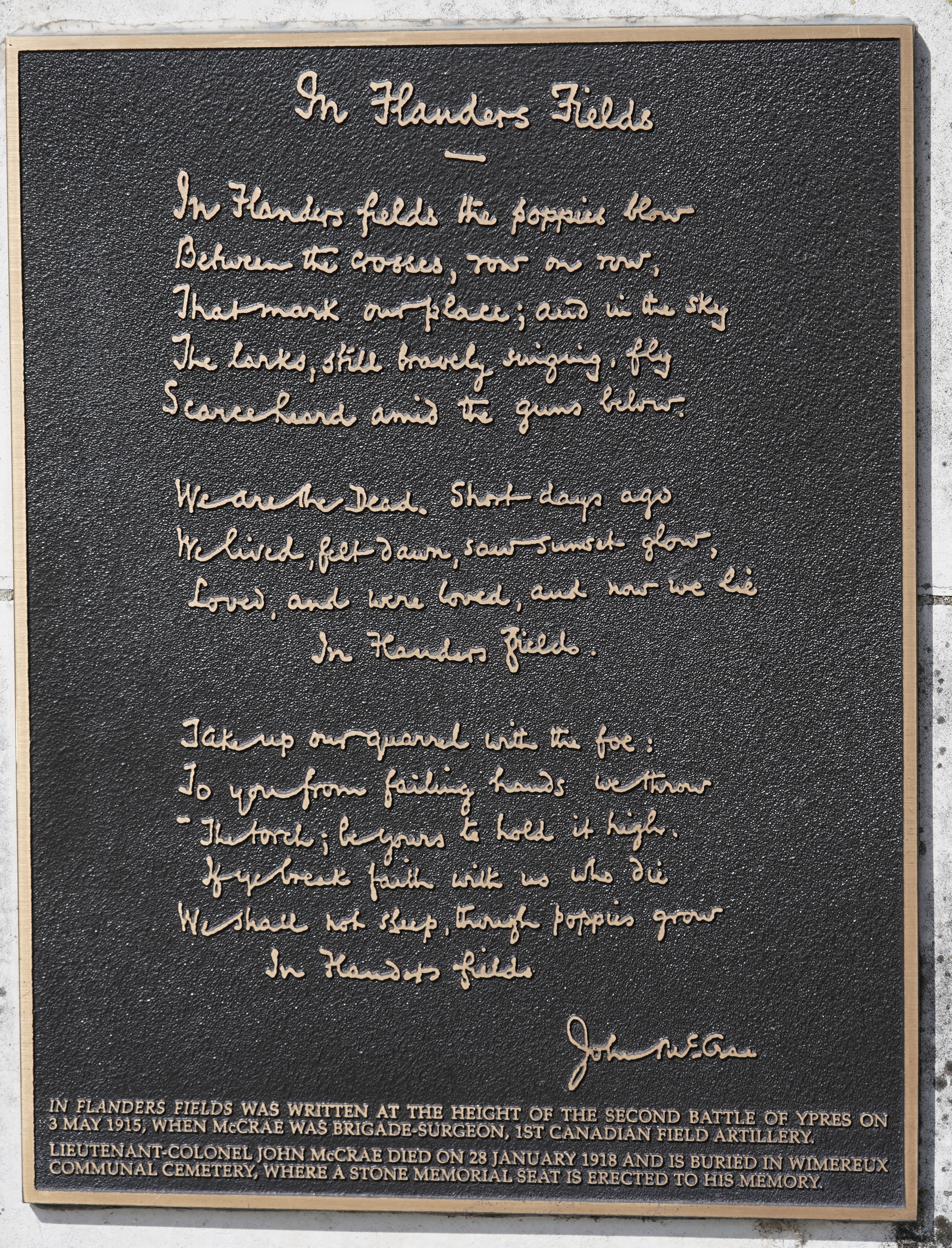
It was at this bunker, that Major (then later Lt. Col) John McRae, medical officer of the 1st Brigade Canadian Field Artillery,  during the Second Battle of Ypres in 1915 wrote "In Flanders Fields" after witnessing the burial of his friend in the cemetery. Due to shelling and the passage of time, the location of the grave of his friend has been lost.


A plaque bearing a copy of the poem, in his handwriting, stands by the bunker.

Lest we forget.


Monday, August 07, 2023

NCL Cruise Day 2 - In Bruges - In Flanders Fields Museum

In Ypres, we headed into the In Flanders Fields Museum.

I will note that on the bus on the way there, a Euro fellow and his kid insisted on signing "In Flanders Fields" loudly, gratingly, and atonally 4 flipping times in a row.

Had they done it for a fifth time, I likely would have buried them In Flanders Fields.  I mean I get being excited and all, but that level of bad singing -- repeatedly, gets rather annoying, this was nails-on-chalkboard quality.

Anyways, it was a relief to get off that bus and into the museum.

The museum is considered one of Europe's best and for good reason.

The museum recounts the history of the First World War in Belgium, and has artifacts aplenty, and preserves and presents many accounts of the fates of those who fought in it.

The museum is rather dark, as befits such a subject, and tends to have subdued or reddish lighting throughout. As befitted the place, people were rather quiet and respectful as they moved through the museum.


It's a great and detailed museum, with a truly excellent collection and cohesive narrative of Flanders in the First Word War.

It ends with you stepping to a hallway leading to the exit, festooned with drapes that list the Wars and casualties in this wars since the War to End All Wars ended.

In short, the Great War really, really, did not end all wars, but you already knew that.

Interestingly enough, some wars in the list are referred to by their English names, and others in French, or Flemish.

After the museum, the tour group broke up to get some lunch on our own.

I got together with a family of guys from Georgia and Virginia who were together for a family trip, and went to a pub with them.  Very nice folks, and we had a great time and conversation.

I had a burger and frites.  

In Belgium, never call frites "French Fries".  The Belgians are rather sensitive about that, and maintain that it was they and not the French who are the inventors of that which we call french fires.   Both the burger and the frites were amazing.

Then we re-boarded the bus for our last stop on the tour - the place that made In Flanders Fields immortal.

Thursday, August 03, 2023

NCL Cruise Day 2 - In Bruges - What Do You Do With Witches?

On boarding the tour bus to head to Ypres, we passed through the commercial area of the port.

Bruges is a major car import/export  port.  The thousands of cars in this lot were, per the guide, supposed to be exported to Ukraine and Russia and have been stuck in this lot since the outbreak of hostilities.


We then drove by the military area of the port


In the port, a Royal Netherlands Navy minesweeper - M864,  HNLMS Willemstad was visiting.

We then hit the road for Ypres.

On the way we passed through the Village of Beselare.

Curious things were afoot.

Beselare, it seems, was having an infestation of witches:


This occurs annually. 

Businesses and households place an effigy of a highly decorated witch, mainly made of straw, outside of their doors in July.

Them, on the last Sunday in July, the effigies are all gathered and a great parade of the witches is held.

Then, what do you do with witches?

Yes, you burn them all in a great bonfire.

Apparently Beselare has a very, very, negative opinion of witches dating back to some unfortunate business in the 17th century.  

This has now become an annual festival of witches that draws quite a number of visitors to the town annually for the festivities.

In addition to the annual creation of the straw witches, there's a permanent bronze statute of a witch in the town square as well:

Leaving the bewitched town of Beselare, we continued on the road to Ypres.