Showing posts with label Jerusalem. Show all posts

Wednesday, August 14, 2019

Israel Day 2: The Hurva Synagogue

After visiting the Church of the Holy Sepulcher, we went through the Armenian Quarter and then to the Jewish Quarter and visited the Hurva Synagogue.

First built in the 1700s it was first destroyed by Muslims in 1721 and then rebuilt in 1864.

The Hurva Synagogue was then completely demolished by the Jordanians after they occupied the Old City in 1948, and they then placed mines in the ruins.

In 1967 after Israel recaptured the Old City, the Synagogue was then rebuilt in its original style, and is used as a place of worship today.

The ceiling has paintings of biblical locations on it such as Rachel's Tomb and King David's Tower.

A model inside shows the building as it is now restored:

Heading up to the top level, we headed to the overlook around the base of the dome of the synagogue.

The views were spectacular:

After visiting the Hurva Synagogue, we exited the Old City through the Zion Gate.

That was the end of a very packed Day 2 in Israel.

Israel Day 2: The Christian Quarter And Churches

On entering the Christian Quarter, we first visited the Lutheran Church of the Redeemer. Built between 1893 and 1898 and dedicated by Kaiser Wilhelm II, who entered Jerusalem for the dedication on a horse to much fanfare.

Then we headed to the Church of the Holy Sepulcher.

During Christian Holidays and the cooler months, the lineup to enter can take hours, if not in some case a day or more. In the late July heat, it was almost no waiting at all.

Here's a picture of the famous (or infamous) immovable ladder at the outside of the Church.

The Church of the Holy Sepulcher is shared by six denominations, each of which guards their claimed portion of the church. This makes any maintenance difficult as if one party does it, the other groups fear it lets them expand their claim. Fistfights can and do occur on a regular basis between monks of the different sects for things as small as moving a chair toward the other's space or leaving a door open at the wrong time.

The ladder apparently was placed there by someone in the first half of the 19th century. Since no one knows who it was or what sect he belongs to, no one dares move the ladder as it might upset the status quo, and its been there since at least 1852 and hasn't been moved since.

Entering the Church you first see the Stone of Anointing, and many pilgrims kneel upon it, pray on it, kiss it, or place objects on it to have them blessed.

Beautiful artwork adorns the walls, telling the story of the crucifxion and resurrection.

Then you find yourself under the rotunda, which lets the sun in casting its rays down into the church.

The you see the The Aedicule which houses the tomb itself.

Interestingly, some sects enter the The Aedicule shrine area by the front entrance and others from the other side, depending on who controls what entrance.

Chapels are all around the Aedicule area, many with extensive adornments.

Some of the pilgrims and worshipers also lit candles in various designated spots.

The Church of The Holy Sepulcher is a very impressive and awe-inspiring building.

Israel Day 2 : More Jerusalem

There was much more of Jerusalem to see.

Next we explored the Cardo, the main-street and outdoor strip mall built by the Romans around 130 AD, and was one of the causes of the Second Jewish Revolt against Rome. Hadrian's renaming Jerusalem to Aelia Capitolina and building a Roman city over Jerusalem rubbed the Jews the wrong way for some very obvious reasons. It was later expanded by Justinian to connect to the Church of the Holy Sepulcher.

The Cardo still remains today, under the current street level and with a supporting superstructure above today.

An illustration of how the Cardo looked in its heyday:

Mainly artisan shops line the modern lower Cardo today including an artist by the name of Udi Merioz, who makes some amazing paintings. It turns out Mr. Merioz was also a personal friend with M.Sgt Roy P. Benividez. Yes, the hero and Medal of Honor holder M.Sgt Roy P. Benividez. An interesting letter to Udi was published in front of his shop, and a picture of M.Sgt Benividez still adorns the inside of his shop to this day:

Then we headed out of the Cardo area and entered into the Christian Quarter.

Thursday, August 08, 2019

Israel: Day 2 Part 2 City of David and Hezekiah's Tunnel

After the ceremony and going to the main Western Wall plaza, we changed and started to explore Jerusalem.

We headed to the City of David, an active archeological site that includes many recent discoveries.

We first headed down into the area of the Burnt House and House of the Bulae - an area destoryed by the Babylonians when the First Temple was destroyed.

Then we headed towards Hezekiah's tunnel, a water system dug in 1750 feet long dug through solid rock in the 8th century BCE. An inscription found inside the tunnel describes it being but by two teams working form either end and then meeting up, which was quite a feat of engineering.

Flashlights in hand we stepped into water up to our knees and headed through the tunnel.

If you have claustrophobia or fear of dark cramped spaces, entry is not recommended. I had to crouch and duck walk through some sections.

On the upside the tunnel was nice and cool and the water was also nice and refreshing for our feet, and where else can you walk through a water tunnel built thousands of years ago?

The map gives a pretty good idea of the layout.

We emerged and passed by a new wall that had been recently found dating to the First Temple Period.

In short Jerusalem is absolutely covered in history, and more history and archeological discoveries are being found there everyday.

And the day wasn't even done yet.

Tuesday, July 03, 2018

Rare Ancient Jewish Coins Found in Jerusalem

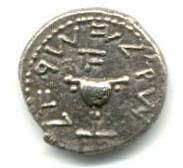
Two impressive new and historically important finds of ancient Jewish coins from the First Revolt against Rome (66-70 AD) have been recently discovered in Israel.

A hoard of Year 4 bronze coins were recovered at the Ophel excavation from a cave near the Temple Mount. Likely buried there as the Romans were besieging and then conquering Jerusalem, its an impressive find of some very rare coins, as the Year 4 bronze and silver coins are quite rare and scarce, mainly because by then the Jews were losing the war and only Jerusalem and a few other outposts remained under Jewish control.

In addition to the hoard of coins found in the cave, a Year 4 Bronze was found in an ancient sewer duct, along with a sword and other accoutrements, under the Hagai Road that led to the Temple helping to verify Josephus's account of the Siege of Jerusalem that fighters and others took shelter form the Romans in drainage ditches where many were killed.

Talk about finds that just ooze history.

Two impressively historic numismatic finds found in Jerusalem within a short time and a short distance apart this year. Very neat indeed.