Showing posts with label Roman. Show all posts

Friday, August 26, 2022

Barcelona Part II - You Never Know What Is In Some People’s Basements

As we walked through he streets of Barcelona we came to an apartment building.

Kinda nice building, not much to talk about really. 

But when they were doing renovations a long time ago,  they dug in and around the basement and foundations and you head down:


They found a Roman Temple dedicated to the Emperor Augustus.

To say it's an impressive sight is an understatement. Just a Roman Temple found in the heart of the core of the medieval city of now modern Barcelona.

There's also a large stone block with an inscription honoring a prominent Romaan Aedile and Priest who lived in the Roman Colony of Barcino which in time became Barcelona.  

The block had originally been at this temple,  but over time had been removed and part of of the foundations of a church moved to a church and was discovered there and then moved back to be placed on display.


Lots of history underfoot and all around you in Barcelona.

Wednesday, August 26, 2015

DaddyBear About To Publish Another Neat Novel

DaddyBear of DaddyBear's Den and author of Tales of the Minivandians is going to have a new book coming out soon.

As you can tell by checking out a snippet he's posted on his blog, Via Serica is going to be a great read and well worth forking over some of your reading denarii to get it home to a place in your library, as will the likely sequels that will continue the tale.

Having had the honor of being one of his beta readers, I can say that the snippets he's posted, unlike a movie trailer, are not representative of the best parts of the entire book. They're really good mind you, but there's some even finer scenes in the book that await. You'll have to wait until it comes out to read it to get those. You're going to enjoy it, especially if you like well written historical fiction with a few twists. You're going to enjoy it a lot.

No spoilers will be given here, so you'll just have to buy the book and go read and enjoy it in its entirety when it comes out.

The book features solid storytelling, an excellent eye for detail of the period, good believable dialogue, lots of taunt action, some hilarious asides, and plenty of Romans roamin' around.

Once he's got a preorder link ready to go on Amazon, I'll throw a link to it here.

Update (September 8, 2015): Via Serica is now avaialble for order at Amazon! Sweet.

Saturday, June 28, 2014

A Time Of Calm - A Coin Of Probus

Peace was a rare commodity in the Roman World, so any cessation of hostilities foreign and domestic, however short-lived, was worth commemorating.

Obverse: IMP C M AVR PROBVS P F AVG (Imperator, Caesar, Marcus Aurelius Probus, Pius Felix Augustus) Radiate, Draped Bust of Emperor Probus right.

Reverse: CLEMENTIA TEMP (Clementia Temporum - a time of peace and calm) The Emperor standing right, holding Scepter, receiving Winged Victory on Globe from Jupiter, standing left and also holding Scepter.

The B in the lower center is the Antioch Mint Officina mark, and the XXI in exergue is not a mint mark, but instead a value marking. It means the coin was made from a ratio of 20 parts bronze to 1 part silver, or 5% Silver.

This antoninianus is in practically uncirculated condition with full silvering, just as an inhabitant of the Imperium Romanum would have seen it when freshly minted. The portrait of the emperor is nice and crisp with excellent detail. Lovely condition for a coin that's over 1,700 years old.

Compared to the prior coin that has had significantly more wear over time with the silver wash worn away and with it showing the bronze underneath.

In the throes of the high inflation that gripped the Roman world at the time, millions of these coins were minted to keep up with the demand for money. Many have survived in everything from miserable to excellent condition and all stages in between, and are easily obtainable for a starting collector of Roman coins.

Saturday, June 21, 2014

Not So Semper FIDES - A Coin Of Probus

Obverse: IMP C M AVR PROBVS AVG. (Imperator Caesar Marcus Aurelius Probus Augustus) Large bust of the Emperor in armor facing right and wearing a double diadem.

Reverse: FIDES MILITVM. (The loyalty of the Armies) III in exerge. Personification of Fides standing facing right, holding a legionary standard in each hand.

Mint mark is III for the Lugdunum mint in Gaul, today known as Lyon. The III indicates the third officinae produced this coin.

The loyalty of the armies was of paramount concern to a Roman emperor, especially in the third century when they were keenly aware of how often emperors were overthrown my their own legions. After all, Probus had just led his army to overthrow the prior emperor Florian in 276 just three months after Florian had been elevated to the purple.

Since much of the monies minted in this period was for legionary pay, propagandizing the military virtues of the emperor, his victories against enemies of Rome, and appealing to the loyalty of the armies as in this coin were very necessary endeavors.

Unfortunately, in 282 AD, the loyalty of the armies to Probus ran out and he was murdered by his own soldiers in Sirmium.

This is an interesting reverse variation because most of the cataloged coins of the Fides Militvm series have Fides facing left, not right.

Saturday, June 14, 2014

Quick! The Emperor Probus Is Coming. Look Busy.

The Emperor Probus was quite a mobile emperor.

Obverse: IMP PROBVS AVG. (Imperator Probus Augustus). Emperor facing right in armor with double diadem.

Reverse: ADVENTVS AVG (The arrival of the Augustus). Emperor on horseback facing left, right hand raised in greeting, left hand holding a scepter, captive at the horse's front feet and RXZ in exerge.

The Mint Mark R(star)Z is for (R) Rome, Z is zeta or seventh officinae, the mint sub-office where the coin was minted, and the star is a control mark. The green flecks you see on the reverse is verdigris, the result of the underlying bronze being exposed to air for a long time, in this case about 1737 years.

The Adventus series of coins commemorate the visit of the emperor to the city designated in the mint mark of the coin. In this case, the coin was minted for his arrival to Rome in 277 AD.

Other cities featured in the Adventus series include Ticinum (Italy), Siscia (Croatia), Lugdunum (in Gaul), Serdica (now Sofia, Bulgaria), and Cyzicus (western Turkey), which indicates a fair bit of traveling for the Emperor.

Coins of Probus are very fun (and affordable) to collect. There's lots to choose from given the variety of types, legends and symbols that appear on his coins. There are 12 different obverse legends alone, and the emperor can be depicted in various types of armor, helmet and weapons, and that's just on the obverse of the coin. On the reverse are multiple types and lots of different mint marks and legends.

Saturday, June 07, 2014

The Virtus Of The Emperor - A Coin Of Probus

Virtus in this case meaning the personification of the military virtues of manliness, courage and virtue. These virtues were vital for a third century Roman emperor to display and propagandize, lest his subordinates consider replacing him with someone more virtuous.

Obverse: IMP C M AVR PROBVS AVG. (Imperator Caesar Marcus Aurelius Probus Augustus) Emperor in armor facing left, wearing double diadem and carrying a spear.

Reverse: VIRTVS PROBI AVG. Virtue walking right, carrying a spear and trophy, Q in the right lower field.

The obverse of the coin shows the Emperor in later roman armor, carrying a spear showing his military virtues, and wearing the double diadem that marks the coin as a double denarius, today known as the antoninianus.

On this coin, the bronze can be seen beneath silver wash on the obverse, but the details of the emperor and his armor remain nice and sharp. A fair amount of the silver wash remains on the reverse with only a few bits of bronze showing through the silver.

This coin, from the Ticium mint, which has a mint mark of XXI. Just like the previous coin of Probus from the mint of Rome, it also has a letter from the word AEQVITI added to the coin's reverse, in this case a Q.

The obverse legend is interesting - Probus a third-century emperor who reigned from 276-282 A.D., is titled as Imperator or emperor, Caesar and Augustus - tying himself to the glory and power of Rome's first emperor and imperial dynasty.

Sunday, March 30, 2014

Beating On the Germans - A Coin Of Probus

It's been quite awhile since I did an ancient coin post.

Next in the series is a coin of the Roman Emperor Probus.

Marcus Aurelius Probus was emperor of Rome from 276-282 AD. As typical for many of the later Roman emperors, he wasn't born in Rome but instead in the city of Sirmium a city in Roman Pannonia, located in what is northern Serbia and the current city of Sremska Mitrovica is located right on top of it. So much on top of it in fact that right beneath the city center is the only known unexcavated Roman hippodrome, a huge building 150 meters wide by 450 meters in length. Unexcavated to this day as they'd have to rip up much of the existing city center to get to it. Sirmium was a very important roman city and made some major cultural contributions to Roman life and indeed nine emperors were born there and many others born near or were proclaimed emperor there.

An emperor in this period needed to display military prowess, and there was no better way to show those abilities than beating back a Germanic tribe or two from the Roman Empire's limes.

The reverse: Victoria Germ. Two captives seated at the foot of a trophy. RAA in exerge.

The Obverse: Probus P F AVG. The emperor's radiate and cuirassed bust facing right.

Sear 3375.

While the coin proclaimed victory over the Germans, and Probus did win many battles against them, the reality of the overall strategic situation was quite different. Under Probus, while there were considerable military victories, the Romans began withdrawing from their fortifications along the Limes Germaicus and abandoned the Agri Decumates area of the Roman province of Germania Superior and retreated to move defensible positions along the Rhine and the Danube rivers.

Probus also worked on revitalizing the Roman economy but came to an early end. In 282 AD at Sirmium, the town of his birth, he was murdered by a bunch of mutinous soldiers who were angry at having been ordered to do construction on public works rather than military duties.

Inflation in the Roman Empire in this period has reduced the Antoninianus to a silver-washed piece of bronze. On this coin, while it weighs 3.92 grams, you can see the bronze coin through the areas where the silver plating has worn away over time and the weight is bronze not silver.

There's also an interesting factoid about some of the coins of Probus. He, or his mint-masters, liked to throw single letters of the word AEQVITI, or equity, on coins.

In the case of this coin, there's an added A found in the mint-mark. The RA of the mark stands for Rome (R), first workshop (A), so we know this coin was minted at Rome itself. The extra A is for the beginning of the word AEQVITI.

Interestingly enough these extra initials only appear on coins struck at the Rome or Ticium mints (mint-mark XXI) and none of the other mints operating during that period. Get enough coins of Probus from Rome and Ticium, and you can gather the extra letters, which are often found in the legend or on the field of the coin and spell AEQVITI at your leisure and feel very equitable while doing so. Why these two mints put that code in the series of coins is unexplained as is why it was limited to only those two mints and what the point was of adding them to the series of coins.

A nice coin commemorating a Roman victory while holding part of a hidden codeword and thereby presenting an interesting lost mystery to history.

Friday, March 15, 2013

Eid Mar - Beware The Ides of March

The assassination of Julius Caesar and today, the Ides of March, was forever immortalized by the conspirators in his death by their striking of a coin, a silver denarius, to commemorate the deed.

The cap of liberty flanked on each side by the daggers that did Julius Caesar in at the Forum.

Of course, it didn't quite work out as the conspirators hoped.

Instead of a return to thier cherished ideal of the better classes ruling with the Roman Senate supreme and no one man predominant, it instead led to a series of bloody civil wars that went on for 14 years, starting in 44 BC and culminating in 30 BC.

The wars resulted in the rise of Octavian as First Citizen and Augustus - the first of the Roman Emperors ansd the end of the dominant power of the Roman Senate.

Sunday, January 13, 2013

Archaeologists Uncover An Ancient Treasure Trove

Fox News: 2,000-year-old treasure found in Black Sea fortress

Residents of a town under siege by the Roman army about 2,000 years ago buried two hoards of treasure in the town's citadel — treasure recently excavated by archaeologists.

More than 200 coins, mainly bronze, were found along with "various items of gold, silver and bronze jewelry and glass vessels" inside an ancient fortress within the Artezian settlement in the Crimea (in Ukraine), the researchers wrote in the most recent edition of the journal Ancient Civilizations from Scythia to Siberia.

I'd love to see the catalog of the coins discovered. Should be an interesitng mix as this was a highway of commerce between Rome and the east, and a relatively rich kingdom on its own at the time.

The find in the Bosporan Kingdom dates to the reign of the Roman Emperor Claudius, who backed Cotys I against his brother Mithridates VIII. Mithridates VIII then declared war on Cotys I. The upheaval which resulted really didn't go well for Mithradates VIII especially as the Romans had some cohorts in the vicinity and had no problem using them. Romans had been rather rough on rulers named Mithridates since the first Mithraditic War and Mithridates VIII was quickly defeated in three days.

Unfortunately, Cotys I didn't long enjoy his reign, being deposed by the Emperor Nero in AD 63 and the Bosporan Kingdom then became a Roman Province.

Sunday, February 19, 2012

A Coin of Gallienus - The Emperor as Germanicus


Obverse: GALLIENVS P F AVG
Emperor wearing radiate crown facing right.

Reverse: GERMANICVS MAX V
Two German captives bound and seated beneath a trophy of captured German arms, armor, and shields.

This coin, another silver Antoninianus, commemorates the victory of the Emperor Gallienus over those troublesome Germanic tribes.

The Germans were getting rather feisty during his reign for the 7 years when he was essentially co-emperor with his father and in charge of the western portions of the empire, and then the 8 years when he was ruling alone, even as other Romans were rebelling and declaring themselves emperor at the same time.

Gallienus, in response to the German invasions went forth and won multiple victories against them in five major campaigns, mainly engaging in battles along the Danube and Rhine rivers.

This coin commemorates his fifth major victory over the Germans, the victory against the Alemanni where he stopped their invasion cold in the Battle at Milan in 259 AD.

To commemorate these five successful campaigns and victories he was given the title Germanicus. The term Germanicus is a Latin honorific term meaning essentially "He who kicked Germanic ass and took names".

Success against the Germanic tribes was always a crowd-pleaser in Rome, and helpful in maintaining the loyalty of the armies as they appreciated being led by a winner. This string of victories against the Germans however, didn't stop a group of Illyrian officers from assassinating Gallienus as he went forth to fight the imposters and rebels Postumus and Aureolus. The Illyrians then named Claudius II emperor.

Sunday, February 12, 2012

An Antoninianus of Galienus - Virtvs Avg


Obverse: GALLIENVS AVG - radiate crowned head of Gallienus facing right

Reverse: VIRTVS AVG - helmeted Gallienus standing holding spear and shield (some catalogers refer to the shield as a globe) with a star below.

On this silver Antoninianus, you can see the bronze peeking through the silver layer applied to this coin. A flan crack also attests to the thinness of the coin itself. The inflationary cycle becomes more acute under this emperor and the silver coinage become more and more debased as the need to pay the expenses of the Empire, most notably its armies, outgrows its receipts. This became acute as the Empire faced multiple threats from outside its borders and multiple rebellions from within.

Virtus was a Roman virtue that stood for and conveyed manliness, valor, courage, and character, a quality vital for an emperor.

As always, the loyalty of the armies was paramount and part of retaining that loyalty was to have the empire depicted as a strong martial figure worthy of their loyalty.

Gallienus sadly did not long maintain that loyalty, even as he advertised his virtus and paid his soldiers well. He was assassinated by a conspiracy of Illyrican legionary officers in March 268 A.D. at the siege of Milan.

Friday, September 23, 2011

Go Roman Around

This is very cool.

René Voorburg of OmnesViae.org has created an awesome interactive online map that allows you to plot routes using the Roman roads, cities, water routes, and forts as shown on the Tabula Peutingeriana. The Tabula, also known as the Peutinger map, is a medieval copy of a Roman Road map from 300 AD.

Now you can see how to travel from Jerusalem to Rome (Romani Ite Domum!).

So how do you say Google maps in Latin anyway?

Saturday, September 03, 2011

Coins of Gallienus: The Praetorians, the VII Legion, and Inflation

In the coins of the Roman Emperor Gallienus, who lived from AD ca. 213 - AD 268 and was Emperor from 253-268, we can visibly see the effects of inflation on the Roman coinage.

Gallienus as emperor had to deal with incursions into the Empire from the Persians and the Goths, slaughtering 50,000 Goths at the battle of Naissus in what is today Yugoslavia. He also had to handle a conflict with Palmyra and he also had to contend with the rebellions of Macrianus and Quietus in the east, Mussius Aemilianus in Egypt, Regalianus in Illyrica, Postumus and Aureolus in the west.

Ensuring the loyalty of the armies during these crises grew increasingly expensive as well as a vital necessity. Inflation occurred with the precious metal content of the coinage steadily decreasing as the Roman fisc tried to keep up with a multitude of expenses both military and civilian.

The Antoninianus, itself an answer to inflation supplanting the denarius, goes from a silver coin to a silver-washed bronze piece.

The coinage of Gallienus bears a multitude of interesting motifs, from wild animals to a series honoring the Roman Legions by name and number, one of only 4 such striking of Legionary coins series in the Roman coinage.

The Legionary series was meant to show the loyalty of the armies and Praetorian cohort was to the emperor even in the face of the numerous rebellions occurring against him.

The Praetorian Cohort Antoninianus:


Obverse: GALLIENVS AVG, Emperor draped bust, facing right with radiate crown.

Reverse: COHH PRAET VI P VI F, radiate lion walking right.

This coin honored the Praetorian cohort.

The Legionary Antoninianus of the 7th Legion:


Obverse: GALLIENVS AVG
Emperor draped bust, facing right with radiate crown.

Reverse: LEG VII CL VI P VI F, (Legion VII Claudia Pia Fidelis) bull walking right.

In September 268, Gallienus was killed in his camp by his own officers. Included in the plot to assassinate him was the commander of the Praetorian Guard, Heraclianus.

Gallienus was succeeded to the purple by Claudius II Gothicus, one of Gallienus' officers and conspirators who arranged his assassination.

Saturday, March 26, 2011

A Coin of Trajan Decius - Dacia and the Dragon Standard

This coin is a silver Antoninianus of Trajan Decius.


Obverse: Draped bust of Trajan Decius facing right with radiate crown.
Inscription: IMP C M Q TRAIANVS DECIVS AVG

Reverse: Personification of Dacia standing left holding standard with a dragon's head.
Inscription: DACIA

The Roman province of Dacia, now modern day Romania, was a Roman province first conquered by Trajan and it became a large and important province with a population between 650,000 to 1,200,000. Dacia was close to Trajan Decius' home province of Pannonia and and important supplier of grain, ore and troops to the Roman Empire.

The legions and auxiliaries from Dacia went into battle bearing dragon standards, as depicted on this coin.

This draco standard was later adapted by other elements of the Roman legions. The standard was continued and carried into battle by Charlemagne and even made an appearance at the Battle of Hastings, and potentially carries on in the United Kingdom today in the representation of the dragon on the flag of Wales.

Numismatically, the draco standard again makes an appearance on money in the modern day, on a modern Romanian banknote, more than 1800 years after its appearance on a Roman coin celebrating the ancient province that became Romania:


Many Roman symbols have enduring resonances that continue through the present day, and the dragon standard is one of them.

Thursday, July 08, 2010

A Huge Hoard of Roman Coins Just Discovered in Britain

The Detroit News: UK treasure hunter finds 52,000 Roman coins 

Talk about a treasure hunter's and coin collector's dream find of a lifetime.
A treasure hunter has found about 52,500 Roman coins, one of the largest such discoveries ever in Britain, officials said Thursday.

The hoard, which was valued at 3.3 million pounds ($5 million), includes hundreds of coins bearing the image of Marcus Aurelius Carausius, who seized power in Britain and northern France in the late third century and proclaimed himself emperor.

Dave Crisp, a treasure hunter using a metal detector, located the coins in April in a field in southwestern England, according to the Somerset County Council and the Portable Antiquities Scheme.

The coins were buried in a large jar about a foot (30 centimeters) deep and weighed about 160 kilograms (350 pounds) in all.
Apparently among the coins in the hoard there are
more than 760 coins from the reign of Carausius, the Roman naval officer who seized power in 286 and ruled until he was assassinated in 293.
The coins of Carausius are pretty rare so this is an important find and who knows, perhpas some new coin types (coins that have not been cataloged as exisitng, for example previously unknown inscripotions or images on the reverse of the coin) will be found.

Congrats to Mr. Crisp on this impressive numismatic and historical find.

Saturday, February 06, 2010

Genius of the Armies of Illyrica - An Antoninianus of Trajan Decius


Obverse: Draped bust of Trajan Decius facing right with radiate crown
Inscription: IMP C M Q TRAIANVS DECIVS AVG

Reverse: Genius standing left with legionary standard to right.
Inscription: GENIVS EXERC ILLYRICIANI - Genius (spirit) of the Armies of Illyrica.

Silver Antoninianus.

C. Messius Quintus Traianus Decius (say that five times fast), known to history as Trajan Decius, was the governor of Lower Moesia. Upper and Lower Moesia are just about where modern-day Serbia and Bulgaria are located. He was sent by Philip I to put down the revolt of Pacatian in Upper Moesia and after the rebels killed Pacatian, he was induced by the same rebels to be the new contender and quickly marched on Rome.

After defeating and killing Phillip I in battle (Philip had himself killed Gordian III to become emperor), Trajan Decius became emperor in 249 AD. His reign lasted 3 short years, coming to a rather dead end in late 251 AD when he was killed in a battle with the Goths at Abrittua.

Like Philip I, the loyalty of the armies was paramount. After all, Trajan Decius came to power by using the legions to dethrone Philip I, and his rule could be subject to a similar challenge by restive army commanders and armies. This coin promoting the spirit of the legions in Illyrica (essentially modern day Albania) was important to ensure the loyalty of the legions receiving these coins there and reminding them who was paying them.

Sunday, January 24, 2010

Loyalty of the Armies - An Antoninianus of Philip I


Silver Antoninianus. AD 244-249, SEAR #2556.

Obverse: Draped bust of Philip I with radiate crown facing Right
Inscription: IMP PHILIPPVS AVG

Reverse: Four Legionary Standards
Inscription: FIDES EXERCITVS

Philip the Praetorian Praefect, after killing Gordian III became emperor and struck this coin -Fides Exercitus - Loyalty of the Armies. A little ironic considering his lack of loyalty to his predecessor in office. Given that the bulk of Roman coins went to pay for the legions, it is unsurprising that the coins carry military themes and celebrate the military victories of the emperor or as in this case, propagandize to the recipients of these coins the need for their loyalty to the emperor and to remind them where their pay was coming from.

One of the main events for which Philip's reign is famous is a series of games held in Rome featuring a variety of wild beasts to celebrate the thousandth anniversary of the founding of the City of Rome. The games were commemorated on a series of coins he struck.

Philip's hope expressed on this coin for the loyalty of the armies was not met. A number of legions rebelled against him and he was killed in battle at Verona against another contender for the Imperium - Trajan Decius.

Saturday, January 09, 2010

An Antoninanus Of Gordian III


Obverse: Radiate crowned draped bust facing right.
Inscription: IMP CAES M ANT GORDIANVS AUG

Reverse: Pax standing left, holding an olive branch.
Inscription: PAX AVGVSTI

Silver antoninianus, Sear #2447, RIC 17.

Gordian III, M. Antonius Gordianus lasted as emperor from AD 238-244. His recent predecessors Gordian I only lasted for 21 days in 238 AD, as did Gordian II his son and co-ruler. There were a total of 6 emperors in conflict and rapid succession in 238, surpassing the famous and far better known year of The Year of Four Emperors, 69 AD. Gordian III was made emperor by the Praetorian Guards after the Praetorians killed the Emperors Balbinus and Pupienus.
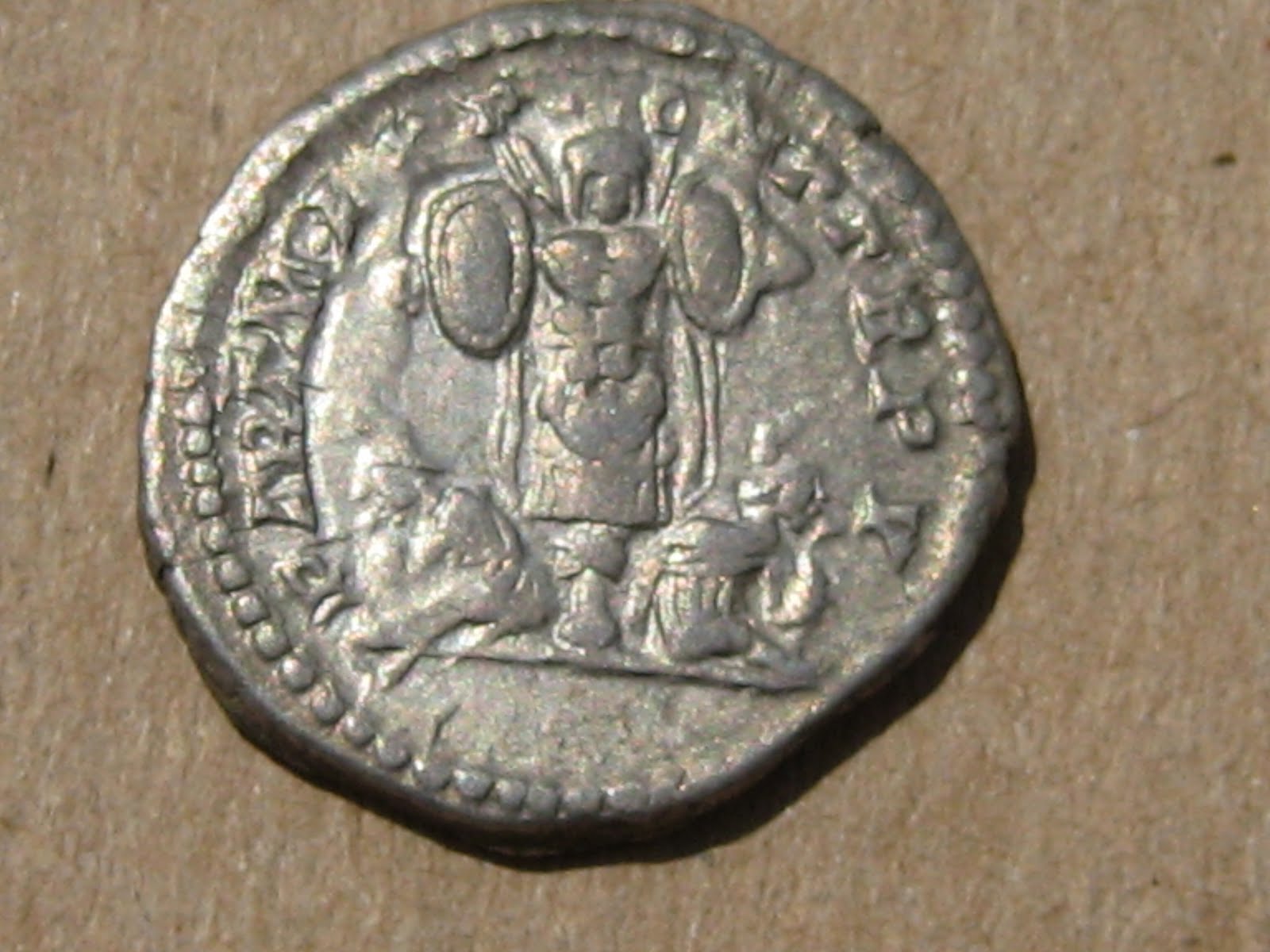
The antoninianus was a replacement for the denarius, a product of the rampant inflation that occurred during the Roman Empire. The antoninianus is also referred to as a double denarius, even as it is only slightly larger than a denarius as historians have not found an agreed upon term for this coin. Given it was introduced by Caracalla (M. Aurelius Antoninianus) it is named after him. The antoninianus are distingushed easily from the slightly smaller denarius as the antoniniani always depict the emperor wearing a radiate crown.

The Antoniniani begin as good silver, and over time with inflation become silver-washed bronze coins, as we'll see later.

The coin is rather ironic proclaiming the Peace of the Emperor, as Gordian's reign did not end peacefully. Gordian III was killed while on campaign in Mesopotamia by the head of his Praetorian Guard, his Praetorian Praefect, M. Julis Phillipus.

Sunday, November 22, 2009

Ancient Coin Post - A Denarius of Caracalla


Obverse: Laureate and drapped bust of Caracalla facing right.
Inscription: ANTONINVS PIVS AVG

Reverse: Trophy with two captives seated at base
Inscription: PART MAX PONT TRP V

This silver coin, slightly larger than a dime, can be dated to precisely 202 AD, as Caracalla had the Tribunician Power, for the 5th time in 202 AD, hence the TRP V on the coin.

M. Aurelius Antonius, better known as Caracalla, was the son of he Emperor Septimius Severus and was Emperor from 198-217 AD. After Severus's death he ruled jointly with his brother Geta until 212 AD when Caracalla had him assassinated so he could rule alone.

The trophy shows off Caracalla's military virtues, important for the loyalty of his soldiers as well as the Praetorian Guard. Caracalla participated in campaigns against the Alamanni in Germany in 213, and two expeditions to Britain in 208 and 210 AD. He was also involved in campaigns against the Parthians, hence the PART MAX - Parthicus Maximus - on the coin inscription.

Caracallas' granting of extra pay also didn't hurt in gaining the troops loyalty either. Caracalla raised the annual pay of an average legionary to 675 denarii and he followed the lesson given him by his father Septimius Severus who had told him to always mind the soldiers and ignore everyone else.

Caracalla however didn't need too much retirement planning as in 217 AD he was assassinated by his Praetorian Guard Prefect Macrinus, which then set off further turmoil and a series of very short lived emperors.

Not until 36 years later, in 253 AD will we find a Roman Emperor that will last for 10 years on the throne. Quite a number of the short lived emperors did strike coins until they were struck down themselves and thus leave behind artifacts of their short lived reigns.

Sunday, November 01, 2009

Ancient Coin Post - An As of Domitian


Obverse: Head of Domitian facing right
Inscription: Caesar Avg F Domitianus Cos Des II

Reverse: Victory facing right placing a laurel on a Roman legionary standard
Inscription: Victoria Avgvsti

Domitian is not making a donkey of himself, this bronze coin is known as an As.

An As, a bronze coin, was worth 1/10th of a silver denarius. Due to inflation, the As was struck relatively infrequently, disappearing from circulation and finally being completely dropped from usage in the 3rd century AD.

This particular coin was struck in 72-73 AD, and it can be dated quite precisely as the coin notes that it was struck when Domitian had been Designated a Consul for a second time (COS DES II), which occurred in 72 CE. At the time Domitian was a Caesar under the Emperor Vespasian, his father.

It is part of the Jewish War Victory Coinage series struck after the Roman victory in the First Jewish War. On the reverse of the coin, the goddess Victory is decorating a legionary standard with a laurel, a symbol of victory.

As for Domitian, he became Emperor after the death of his brother Titus, who had succeeded Vespasian. Domitian is the last of Suetonius' The Twelve Caesars . Suetonius, writing in the age of Nerva finished his racy and interesting chronicle with the death of Domitian. Domitian ruled for 15 years, finally being assassinated in a palace conspiracy and he was replaced as Emperor by Nerva. Domitian suffered the damnatio memoriae, or the removal of references to him in public records, the melting down of his coinage and the defacement and removal of his image in public artwork.

This was my first ancient Roman coin purchase back in 1990, and it marked the end of my modern coin collecting habit and the start of years into the study and collecting of ancient coinage.

As an interesting aside, the British Museum Catalog number for this coin is BMC II p.144, *, meaning that it is in the second volume of the British Museum Catalog, which is an excellent reference for Roman Coins as the British Museum has one of the finest collections anywhere. However, the * in the catalog number means they lack an example of this coin in their collection, so I have at least one coin that they lack.