Showing posts with label USS Yorktown. Show all posts

Friday, January 22, 2021

USS Yorktown - The Flightdeck - Marine Hornet!

The F/A-18 Hornet replaced the venerable F-14 Tomcat in the Navy's fighter line-up, as well as replacing the A-6 Intruder and the A-7 Corsair II as an attack aircraft.


This one is in the livery of VMFA-142, a Marine squadron with a legacy back to the Second World War, participating in the Guadalcanal campaign.  The squadron was inactivated in July 2008.


The F-18 has served with the US Navy, US Marines and a number of foreign countries including Australia, Canada, Finland, Kuwait. Malaysia, Spain, and Switzerland.  The F-18 A-D series has now been replaced in US Navy front-line combat squadrons by the F/A-18 E/F Super Hornets and  the F-35.  The Blue Angels have also turned in their F/A-18s for the Super Hornets.

Thursday, January 21, 2021

USS Yorktown - The Flightdeck - The Tomcat Prowl

What would a tribute to carrier aviation be without the Grumman F-14 Tomcat?

The Tomcat, made famous in the movie Top Gun, is a large, twin-engined, two seat, swing-wing supersonic fighter and interceptor.


First deployed in 1974, it served with the US Navy until 2006 being replaced with the F/A-18E/F Super Hornet.    The F-14 scored its first air-to-air kill in 1981 when a patrol of F-14s was engaged by, and then downed Libyan Sukhoi jets.


Tomcats were also adapted to fly air-to-ground missions with the ability to drop both precision-guided and non-precision bombs.  The moniker Bombcat was often applied to these upgraded aircraft.  F-14s took on air-to-ground missions in Iraq, Bosnia and Kosovo.


Interestingly, the F-14 on the USS Yorktown bears the markings of two different squadrons on the aircraft.

It bears markings of aircraft #103 of the USS George Washington on the port side with the squadron markings of VF-143, the Pukin' Dogs.

On the starboard side it is painted with the livery of the USS KittyHawk, Aircraft #101 of squadron VFA-154 The Black Knights.

Tuesday, January 19, 2021

USS Yorktown - The Flight Deck - The Mighty Sea King

For you rotorheads out there, there was a Sikorsky SH-3G Sea King on the flight deck.

The Sea King's size is something to behold in person.  Note the lady standing to the left for scale.

This one is marked as number 61 from  Helicopter Anti-Submarine Squadron 4 (HS-4)  now called Helicopter Sea Combat Squadron Four (HSC-4).  HS-4 served on 6 deployments on board the USS Yorktown from 1960-1968.  The squadron also set a record for the most downed airmen recovered,  24, on a single cruise in 1966 by an ASW squadron when the carrier was deployed in the Gulf of Tonkin.  

The Sea King is an amphibious helicopter and has done everything from antisubmarine and search and rescue work, to ferrying presidents, and even recovering returning Apollo space craft.


Monday, January 18, 2021

USS Yorktown - The Flight Deck - Skyhawk!

At the stern of the Flight deck an A-4 Skyhawk sat with its arresting hook deployed.


The A-4 Skyhawk was an outstanding light attack aircraft.


This one is pretty well wrapped up.


Designed in the early 1950's by Douglas'  brilliant aircraft designer Ed Heinemann, it came in under both the weight and cost limits of the Navy contract that led to its creation.  It proved to be a very successful design remaining in production until 1979.

While a lightweight strike aircraft, weighing 9,853 lbs, it can carry the same bomb load as that of a B-17 Bomber that weighted 34,000 lbs.

2,960 Skyhawks were produced and they served in some of the notable conflicts of the 20th century - The Vietnam War, The Yom Kippur War, The Falklands War, and The First Gulf War.

Monday, January 11, 2021

USS Yorktown - The Flight Deck - The Eyes And Ears Of The Fleet


The Grumman S-2 Tracker

The Grumman S-2 Tracker, or the "Stoof", introduced in 1952, was the first Anti-submarine warfare aircraft designed specifically as an ASW aircraft for the US Navy.  The Tracker and served on Essex-class carriers like the USS Yorktown and others.

The Tracker served as an ASW aircraft and as search and rescue operations with multiple foreign nations from both carriers and land based stations.  

The only remaining country  to operate the Trackers operationally in their military is Argentina.  

Trackers still continue to serve and fly today in civilian hands as water-bombers.

The Grumman E1-B Tracer

The "Stoof with a Roof" was Grumman's Airborne Early Warning aircraft.

The Tracer could and did operate from the decks of the Essex-class carriers, providing airborne early warning and control to Navy aircraft.

 and served in the fleet from 1959-1977 when it was completely replaced by the E2-A Hawkeye, which was too heavy to operate off of an Essex-class carrier.


Douglas EA-3B Skywarrior


Another huge aircraft on deck. Note the person standing helpfully to the left for scale. The Skywarrior was the heaviest operational aircraft to operate from a US Carrier, but it did indeed operate from the Essex-class carriers as well as their larger successors.

Originally designed as a nuclear heavy bomber for the Navy, it entered service in 1956.  The EA-3B was quickly phased out of nuclear attack with the ballistic missile submarine taking over the nuclear role, and it soon took on an electronic warfare and reconnaissance role.

The EA-3B served on through the first Gulf War, and was retired from service in 1991.

The number on this electronic warfare plane - 007.

USS Yorktown - The Flight Deck - Site Of The Intruder

The Grumman A-6 Intruder served as a long-range attack aircraft from 1963 through 1997 with both the Navy and the Marine Corps.

This one flew off the USS Independence.

The Intruder's payload and range have yet to be matched by serving carrier-based Navy and Marine aircraft.

84 Intruders were lost during the Vietnam war due to various causes.  One was shot down over Lebanon in 1983, and three were lost in the Gulf War.


It was also the star of the eponymous movie Flight of The Intruder.  The movie sadly showed that while fighter pilots make movies, bomber pilots make not nearly as good movies. 

Friday, January 08, 2021

USS Yorktown - The Flight Deck - Take A Couple Chances

Two fantastic and historic aircraft from Chance Vought were on the flight deck.


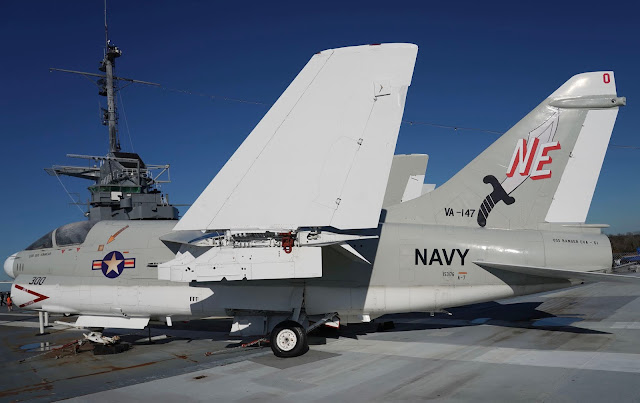
 The A-7 Corsair II, often lovingly referred to as the SLUF (Short Little Ugly Fellow*).

A subsonic light attack, fighter, and tanker aircraft, the A-7 served in both the Navy and Air Force and with foreign militaries.

Interestingly, the A-7 never served with the US Marine Corps, unlike its famous predecessor in name, the F4U Corsair. 

The A-7 served in the US Navy from 1967-1991, and served on in the Air National Guard until 1993, and the A-7 continued to serve with the Greek Air Force until being retired in 2014.

This aircraft on the flight deck served with VA-147, the first Navy squadron equipped with the A-7 Corsair II in 1967.
The next Chance Vought aircraft on deck, parked right beside the A-7 is the F-8 Crusader.

The F-8 Crusader, often called the Last Gunfighter, as it was the last US fighter plane designed to have guns as its main armament, was a supersonic fighter. 

A variant, the RF-8, served as a photo-reconnaissance aircraft, most importantly during the Cuban Missile crisis.  

The fighter versions entered into service in 1956 and served in the Navy until 1976. The last photo reconnaissance variant was retired from the Navy in 1987 and the final F-8 aircraft in active service with a foreign power was retied from the French Navy in 2000.    Not a bad run at all.

Interestingly, the F-8 was the only fighter to carry the AIM-9C radar guided version of the normally heat-seeking Sidewinder missile.

The aircraft, while visually similar to the A7 is larger, has an afterburner, a greater angle to its swept wing, as well as a more pointed nose.

Again, the planes were tested and found to be well and truly Murphy-proofed. 


Thursday, December 31, 2020

USS Yorktown: The Hangar Deck, Like Gaul

Is divided into three parts.  

The hangar deck has enormous blast doors dividing the deck into three separate sections.  This protects the hangar deck and stores located inside from damage during battle. Originally there were three aircraft elevators to move the planes to and form the flight deck from the hangar deck.  Later modifications removed one of the elevators.

It's a very large  space, crammed with interesting exhibits, history and many artifacts of the Yorktown, and a special exhibit about her sister carrier the USS Franklin and how it survived crippling damage from an air attack in March 1945 due to the heroism and effort of her crew.  The attack had killed 800 of its crew, yet the ship was saved and returned to service after incredible damage.

A 40mm gun mount from the Franklin is on display  on the hangar deck, with some damage from the attack still visible.


 There's also a very good movie shown in by the memorial about the Franklin to the left of the gun mount that is well worth watching.

There's plenty of aircraft on display as well:

A Stearman biplane navy training aircraft:


The many types of aircraft that the Yorktown operated are on display:

The F4F Wildcat -


 The initial main American naval fighter of the war.  While inferior to the Zero, it was made famous in the hands of aces like O'Hare and Thatch, and proved to be able to meet the Zero on its own terms when the right tactics were used.

The F6F Hellcat - The US Navy's highest scoring aircraft of World War 2 and successor to the Wildcat:


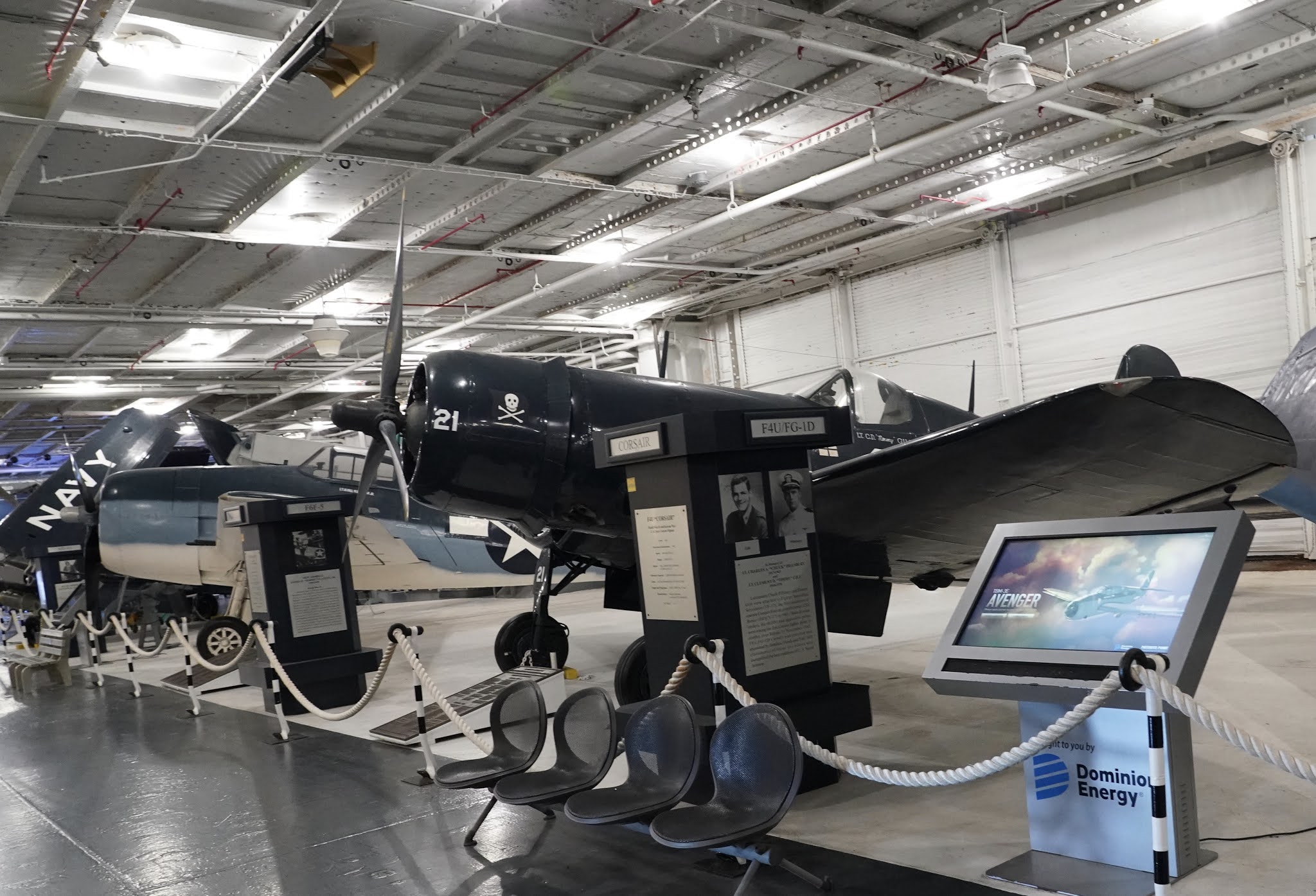
The F4U Corsair:


The Douglas A-1 Skyraider


The Grumman Avenger TBM torpedo bomber:


The SBD Dauntless dive bomber:


 The F9F Cougar - bringing the Yorktown into the jet age.  Subsequent Navy jets quickly began to become too heavy to operate off the Yorktown.


Yorktown recovered the astronauts of Apollo 8, after their historic flight around the Moon in December 1968; so there are some space related exhibits, including a mock Apollo capsule:


And a mock up of the Friendship 7, the Mercury spacecraft piloted by John Glenn.


The hangar deck makes for an impressive display of the history of American naval air power.

Wednesday, December 30, 2020

Maneuvers With Murphy's Law - To Patriot's Point

One of the cunning reasons that Murphy's Law had come along, in addition to the fact that he's a great guy and friend, was that he and I could go forth and do some guy things while the ladies went off to do their things.

To put it another way, the family was not about to have me traipse them all over, up, down, and around the Aircraft Carrier, Destroyer and other features of Patriot's Point.  They sadly just lack appreciation and the attention span for studying our nation's military history in sufficient detail.

Now with Murph, traipsing everywhere at Patriot's Point where we were allowed to go, and, ahem, some places we weren't, was just what was in store.

In short, this was a win-win scenario.

First, I must declare that if you are traveling in the Charleston area of South Carolina, Patriot's Point is not to be missed. 

As you approach the dock, you see the DD-724, USS Laffey


Behind the USS Laffey, and much more on this historic ship later, sits the mighty USS Yorktown, CV-10. Named for the carrier Yorktown sunk at the Battle of Midway, this Yorktown was to blaze its own path in the history books in World War 2 and beyond.


We decided to explore the Yorktown first.  We also signed up for the special guided tour, which was well worth it.

You begin to get an appreciation for the sheer size of the Yorktown as you walk up to it, and it's about a third of the size of today's supercarriers.


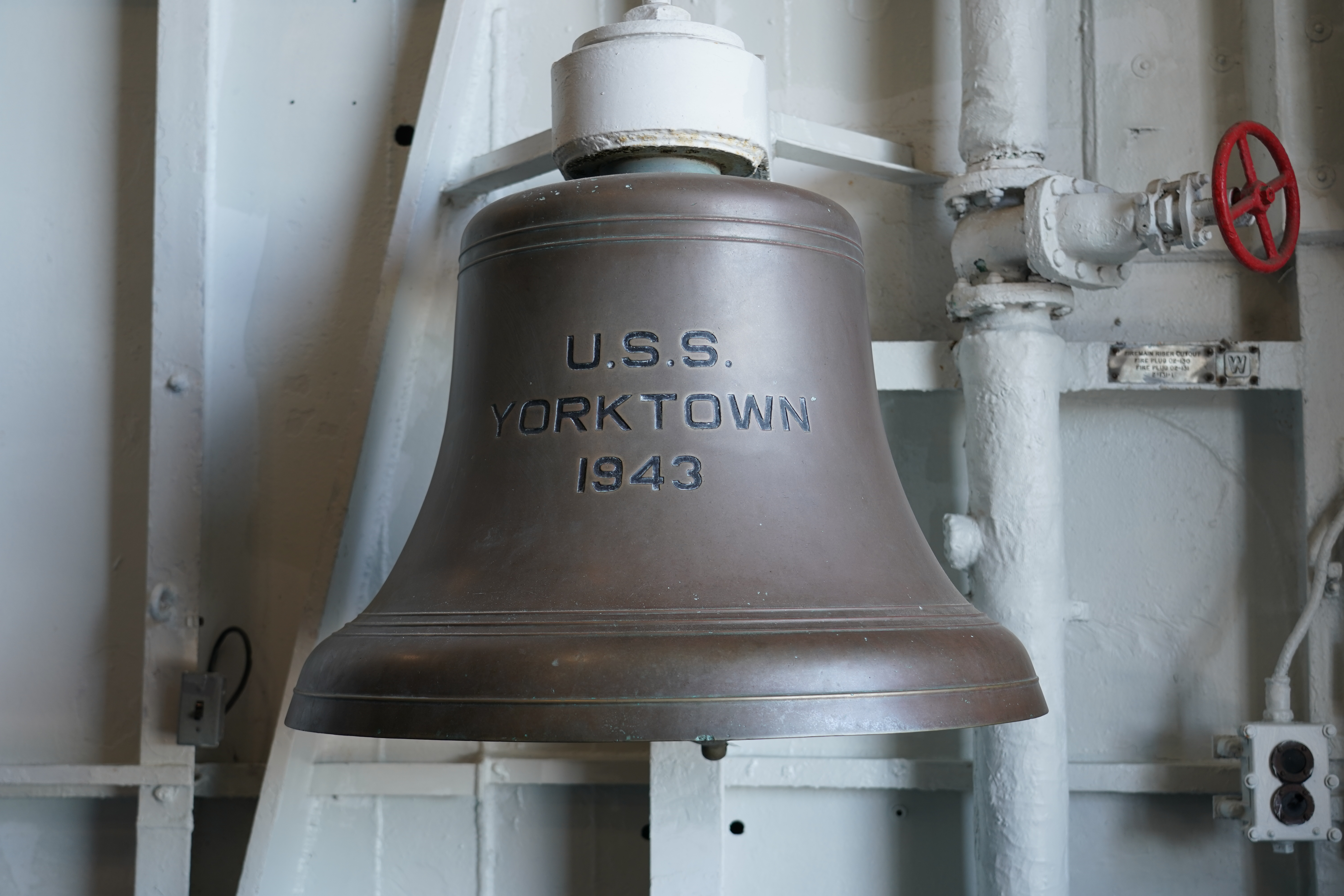
Up those stairs you enter the Yorktown and see the ships' bell and the Presidential Unit Citation Awarded to the ship:


Quite a proud service record, and the Yorktown was surely in the thick of the fighting in the Pacific.

Then we walked into the ship and began to explore the hangar deck.